The Vagus Nerve and Anxiety: What Actually Works for Nervous System Regulation (and What's Just Wellness Hype)
If you've spent any time on wellness social media recently, you've probably come across it. Ice baths. Humming devices. Ear clip stimulators. All of it promising to "activate your vagus nerve" and transform your anxiety, your mood, your entire nervous system in minutes.
As a CBT and Compassion-Focused therapist, I want to give you the honest version. What the vagus nerve actually is, what the evidence genuinely supports, and what's being sold to you with considerably more confidence than the science warrants.
What Is the Vagus Nerve and Why Does It Matter for Anxiety?
The vagus nerve is the longest nerve in your body. It runs from your brainstem all the way down through your heart, lungs, and digestive system which is why anxiety so often lives in the body as much as the mind. Racing heart. Churning stomach. Shallow breathing. That's your vagus nerve and the systems it connects.
It forms the main highway of your parasympathetic nervous system, the part responsible for rest, digestion, and calm. When your vagus nerve is responding flexibly to stress, and recovering well, you're better able to regulate your emotions, manage anxiety, and return to a calm baseline after something difficult.
So far, so good. The science here is solid. The problem comes with what the wellness industry does with it next.
Why "Vagal Hacks" Are More Misleading Than They Look
You've probably come across the term "vagal tone." In short, it describes how flexibly your nervous system responds to stress, and how quickly it can bounce back and rebalance itself after something distressing.
The wellness world has latched onto this idea and run with it. Cold plunges. Vagus nerve stimulation devices. Promises of a complete nervous system reset in a single session. And on the surface, some of these things do activate the vagus nerve acutely. But here's what's missing from that conversation: acute activation is not the same as lasting change.
What this messaging teaches, often without meaning to, is that your nervous system is something you can simply switch on or off. That anxiety is a lever you can pull. Not only is this scientifically misleading, it's damaging too. It tells you that if your anxiety hasn't disappeared after your cold shower, something must be wrong with you, rather than recognising that nervous system regulation is something built slowly, through consistent practice, safety in relationships, and a fundamentally different relationship with yourself.
Vagal tone isn't something you hack in five minutes. It's something you develop over time.
And if anything promises an on/off switch for your mental health, that's usually a sign it's more trend than science.
Evidence-Based Ways to Support Your Vagus Nerve
Slow, extended exhale breathing.This is the most consistently evidenced vagus nerve technique available. Breathing with a longer exhale than inhale. For example, inhaling for four counts and exhaling for six to eight directly activates the parasympathetic nervous system. It's free, it works, and you can do it anywhere. Even two minutes produces a measurable difference in heart rate variability (HRV).
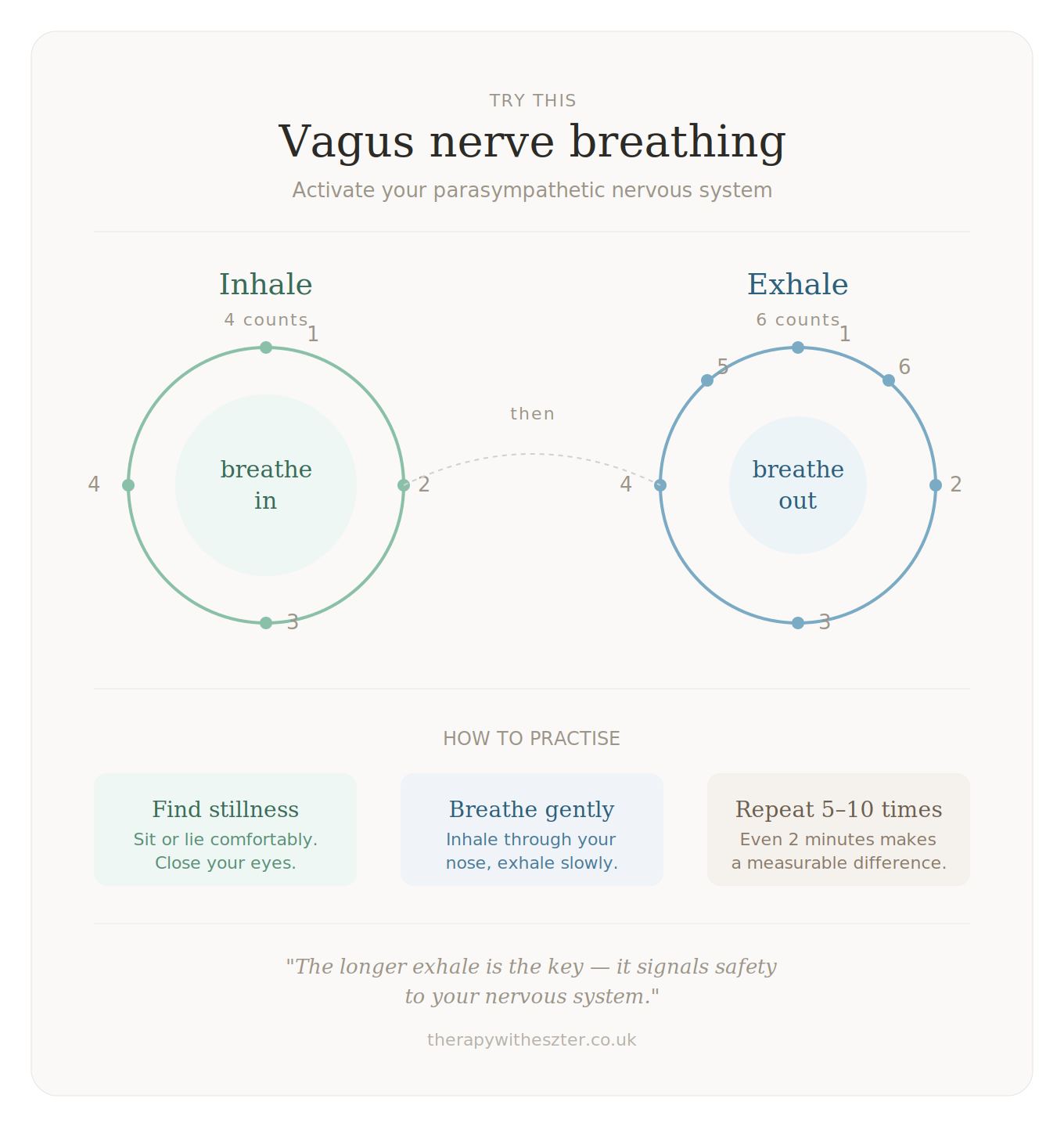
A visual guide to vagus nerve breathing — inhale for 4 counts, exhale for 6. This simple, free technique activates your parasympathetic nervous system, improves vagal tone, and can reduce anxiety in as little as 2 minutes. No equipment needed.
Regular physical exercise.Aerobic exercise improves vagal tone over time. Not dramatically, not overnight, but reliably. Walking, swimming, cycling. Nothing extreme required.
Social connection and co-regulation. This is the one the wellness industry tends to skip, because you can't sell it. The vagus nerve is profoundly social. It evolved partly to help us detect safety in other people's faces and voices. Time spent with people you genuinely feel safe with is one of the most powerful nervous system regulators we know of.
Humming, singing, and chanting. These do appear to stimulate the vagus nerve via the throat. The evidence is reasonable rather than strong, but it costs nothing and the worst outcome is feeling slightly silly.
Practising self-compassion. This one deserves its own section, because it's the piece most consistently left out of the conversation, and arguably the most important.
Why Self-Compassion Is One of the Most Powerful Nervous System Regulators We Have
When I first mention self-compassion to clients, I often see a visible cringe. Compassion? They picture something warm and slightly wishy-washy. Kind, maybe, but not particularly clinical.
I understand that reaction, but I want to explain why that isn’t true.
Compassion-Focused Therapy (CFT), developed by Professor Paul Gilbert, is built on a neuroscience framework that maps our emotional experience across three systems: the threat system (anxiety, anger, self-criticism), the drive system (motivation, achievement, striving), and the soothing system (calm, safety, connection). Most people who struggle with anxiety or low self-esteem are running predominantly from their threat system. Their nervous system is effectively stuck in a low-level state of alert scanning for danger, braced for the next thing to go wrong.
Self-compassion directly activates the soothing system. When we treat ourselves with warmth, even imperfectly, even briefly, it triggers the release of oxytocin and activates the parasympathetic nervous system. This isn't just a nice idea. It's a physiological event that directly calms the threat response.
Self-criticism does the exact opposite. When we turn on ourselves and say things such ‘I'm so stupid, I should have done better, what's wrong with me’ the brain registers it as a threat. Your nervous system cannot distinguish between being attacked by someone else and being attacked by yourself. The same stress hormones are released. The same alarm bells ring.
This is why harsh self-criticism doesn't motivate change, it keeps your nervous system in threat mode, which is the very state you're trying to move out of.
Developing a warmer, more compassionate inner voice trains the soothing system over time. It builds exactly the kind of vagal tone that wellness content promises but rarely delivers.
In my work with clients, self-compassion isn't a soft add-on to the "real" therapy. It is physiologically central to nervous system regulation. When someone learns to meet their own distress with warmth rather than criticism, they are quite literally changing the neurological environment in which their anxiety lives.
You cannot bully your nervous system into calm. But you can, over time, teach it that it is safe. Practising self-compassion is one of the most direct ways to do that.
What This Means Practically; How to Start Regulating Your Nervous System
If you're struggling with anxiety, here's the honest summary of what's worth your time.
Do the slow breathing. Go for your walks. Call someone you feel genuinely safe with. Try humming if you're curious. These are low-cost, evidence-supported, and genuinely helpful approaches to vagus nerve stimulation and stress relief.
Be sceptical of anything that promises to fix your nervous system quickly, expensively, or in isolation, especially if it sidesteps the harder, more lasting work of changing how you relate to yourself.
Your nervous system doesn't respond well to being pushed into calm. It responds to consistency, to safety, and perhaps most powerfully to learning that you are on your own side.
That last part is exactly what Compassion-Focused Therapy works on. And the neuroscience says it matters.
If you're struggling with anxiety or self-criticism and would like to explore how CBT or Compassion-Focused Therapy could help, you're welcome to get in touch via the contact tab or book a free 15-minute consultation.