It's late. You should be asleep. Or maybe it's mid-afternoon and you're supposed to be doing something else entirely.
But here you are, scrolling. Headlines. Threads. More headlines. Your thumb moving almost on its own, through a feed that's making you feel progressively worse, while some quiet part of you wonders why you can't just... stop.
If this sounds familiar, I want you to know something before we go any further:
This isn't a character flaw. This isn't weakness. This is your nervous system trying to keep you safe in the only way it currently knows how.
And I say that not to let you off the hook, but because understanding why you doomscroll is the first step to actually changing it. Self-criticism rarely is.
What Doomscrolling Is Really About
On the surface, doomscrolling looks like mindless habit. In therapy, it almost always turns out to be something more meaningful than that.
For many of the people I work with, doomscrolling is a form of anxiety management, and a very understandable one. When we feel uncertain, out of control, or quietly overwhelmed, our brain generates an urgent need to gather information. If I just know enough about what's happening, I'll feel safer. The scroll feels like doing something. Like staying prepared. Like not being caught off guard.
There's also something else happening that's worth naming: for some people, doomscrolling is actually a way of escaping from their own internal world. When the inner critic is loud, when your own thoughts feel relentless, harsh, or exhausting, turning outward to the chaos of the news can feel like relief. At least out there, the noise isn't about you.
Both of these patterns make complete sense. And both, gently, are worth exploring.
The Cruel Irony of Reassurance-Seeking
Here's what makes doomscrolling so difficult to simply "stop", it works, briefly.
Each scroll gives your brain a tiny hit of the feeling that you're doing something about the anxiety. And then the next headline arrives, and the anxiety spikes again, and the urge to scroll returns, slightly stronger than before.
In CBT, we call this a maintenance cycle. The behaviour that feels like relief is actually the thing keeping the anxiety going. It's the same loop that underlies health anxiety, social anxiety, and the kind of relentless overthinking that can feel impossible to switch off.
If you've ever found yourself thinking "I'll just check once more and then I'll feel better" about the news, about social media, about what other people think of you, you'll recognise this pattern. The relief never quite arrives. And the checking continues.
This isn't a moral failing. It's a very human response to anxiety. But it is something that can change.
A Word About the Inner Critic
I work a lot with people who have a particularly harsh inner critic. That internal voice that amplifies mistakes, dismisses achievements, and runs a quiet commentary of not good enough in the background of daily life.
For these clients, doomscrolling often has an extra layer. Sometimes it's a way of numbing that voice temporarily. Sometimes, and this is harder to sit with, scrolling through suffering in the wider world serves as a strange kind of comparison: at least I'm not dealing with that. And sometimes, absorbing the world's pain feels more tolerable than sitting with our own.
None of this is conscious. None of it is something to judge yourself for. But in therapy, these are exactly the kinds of patterns worth getting curious about. Not with criticism, but with gentleness and real interest in yourself.
If You Have ADHD, This Hits Differently, And Here's Why
I want to speak directly to those of you who have ADHD, or who suspect you might, because doomscrolling with an ADHD brain is a whole different experience, and it deserves its own honest conversation.
If you've ever found yourself completely unable to put your phone down, even while a voice in your head is saying stop, stop, stop and you've beaten yourself up about it endlessly, please hear this: there is nothing wrong with your brain. It is wired in a way that makes this particular trap extraordinarily hard to escape.
Here's why.
The dopamine piece ADHD is associated with lower baseline levels of dopamine. The neurotransmitter linked to motivation, reward, and that feeling of satisfaction when something goes well. Because of this, the ADHD brain is in a near constant state of seeking stimulation, and the internet provides an endless supply of novel content to meet that need. Each new headline, each new post, delivers a small hit. Not enough to feel genuinely good, but just enough to keep going.
Unlike the slow, earned dopamine that comes from completing a task or engaging deeply with something, doomscrolling provides fast, irregular spikes. Over time, the brain adapts to this pattern, making everyday activities feel dull and unrewarding by comparison. This is why, after an hour of scrolling, you can feel simultaneously overstimulated and completely flat.
The hyperfocus trap ADHD brains don't just get distracted, they also hyperfocus. And doomscrolling is almost perfectly designed to trigger it. Difficulties with impulse control and hyperfocus can lead to prolonged screen time and mental exhaustion that can feel impossible to pull back from. You're not choosing to stay. You're genuinely stuck. And that's a very different thing.
The avoidance cycle There's often something else going on too. For many people with ADHD, doomscrolling is part of a larger avoidance pattern: get overwhelmed by a task, avoid the task, scroll to escape, run out of time, feel worse and repeat. The scroll isn't random. It's a response to the executive function challenges that make starting, switching, and completing tasks genuinely harder for ADHD brains.
The shame spiral And then comes the part that breaks my heart a little, because I see it so often. The scrolling stops (eventually), and in its place arrives a wave of self-criticism. Why can't I just control myself? What is wrong with me? Everyone else seems to manage this fine.
This shame is not only painful, it actively makes the ADHD symptoms worse. Shame is a threat state, and a threatened nervous system is an even less regulated one. The inner critic, in this context, isn't helping you do better. It's keeping you stuck.
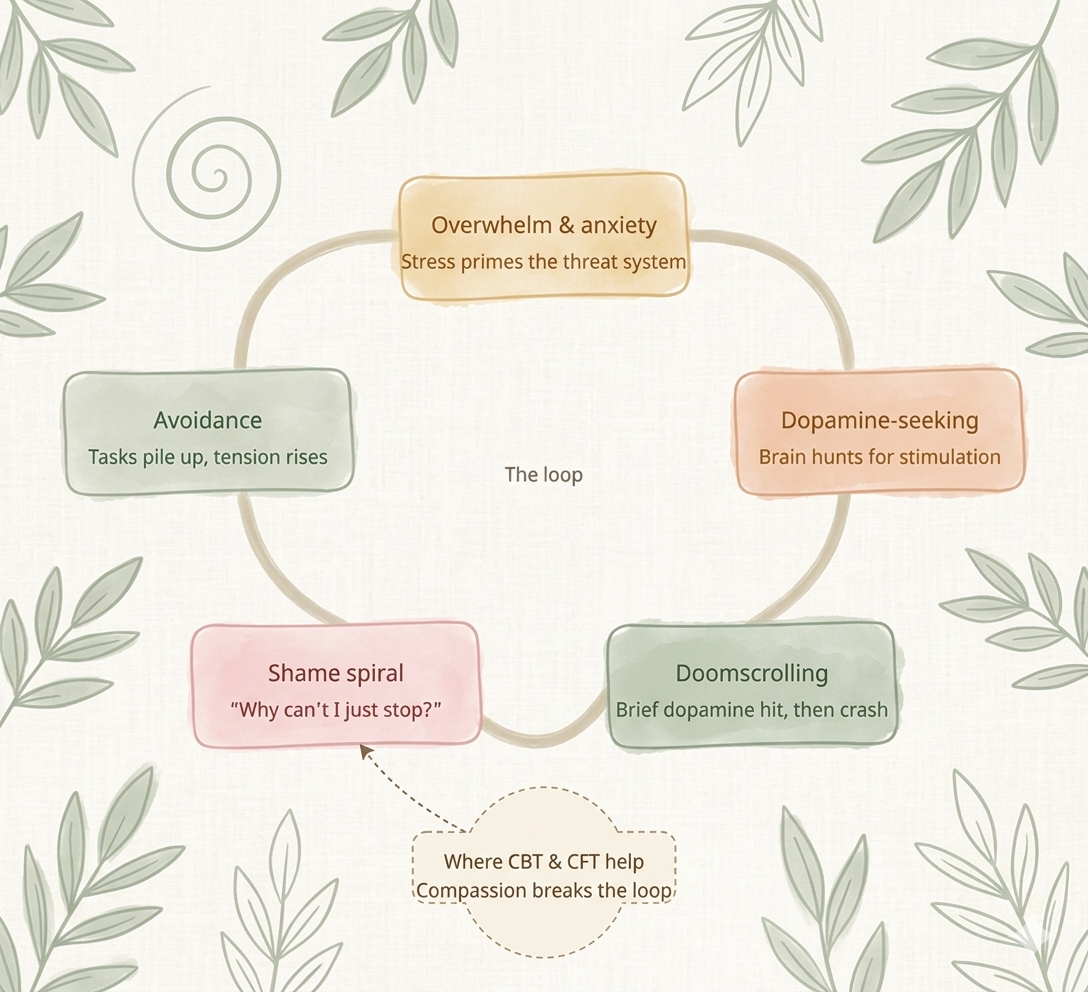
CBT therapist explains ADHD doomscrolling cycle and self-compassion tools
What actually helps if you have ADHD The CBT tools later in this post are all relevant, but for ADHD brains, a few things are worth layering in:
External structure over willpower. Relying on self-control alone is setting yourself up to fail. Use app timers, phone-free zones, or keep your phone in another room at certain times. Make the environment do the work your brain finds hard.
Transition rituals. ADHD brains struggle with task switching. Having a small, consistent ritual to close one thing and begin another, even just making a drink and sitting somewhere different can help your brain shift gears.
Self-compassion is not optional. For ADHD clients especially, the shame around habits like doomscrolling is often the biggest obstacle to change. Learning to respond to your own struggles with kindness rather than criticism isn't just reccomended, it's neurologically necessary. Shame dysregulates. Compassion regulates.
If you've always wondered whether your relationship with your phone (and with distraction more broadly) is "normal", it might be worth exploring, either with your GP or with a therapist who understands ADHD and anxiety. You deserve support that actually fits how your brain works.
What Compassion-Focused CBT Suggests Instead
I want to offer you some tools here, not as a to-do list to beat yourself up with if you don't manage them perfectly, but as genuine invitations to try something different.
Notice without judgment first - Before anything else, just start noticing. When do you reach for your phone? What were you feeling in the moments before, anxious, bored, sad, irritable, disconnected? You don't have to change the behaviour yet. Just get curious about it. Awareness, in CBT, is always the first step.
Ask yourself what you actually need - Often, the urge to scroll is pointing at something else. Loneliness. Overwhelm. A need for connection, rest, or comfort. When you notice the urge, try gently asking: What am I actually looking for right now? The answer might surprise you, and it might point you toward something that actually helps.
Experiment with time-boxing your news - Rather than trying to stop entirely (which tends to increase preoccupation), try containing it. Two short windows a day. Perhaps at lunch and in the early evening is enough to stay informed without living in a state of constant alert. Outside of those windows, you're not being irresponsible. You're choosing to protect your nervous system.
Practice soothing, not just distracting - When anxiety is driving the scroll, what your nervous system actually needs is regulation, not more information. Slow breathing (four counts in, six counts out. The longer exhale activates your parasympathetic system), a warm drink, gentle movement, or simply placing a hand on your chest and taking one slow breath. These feel small. They aren't. They're telling your threat system that you are safe, right now, in this moment.
Bring compassion to the moments you do scroll - If you catch yourself an hour deep into a news spiral, the least helpful response is to add a layer of self-criticism on top of the anxiety. Instead, try treating yourself the way you'd treat a friend who'd done the same: Of course you did that. You were struggling. Let's just start again.
This is the heart of Compassion Focused Therapy. It's not soft or indulgent, It's actually one of the most powerful ways to break cycles that self-criticism has kept locked in place for years.
You Don't Have to Keep Running From Your Own Mind
If doomscrolling has become a significant way that you manage difficult feelings such as anxiety, self-criticism, low mood, or a sense of being overwhelmed by the world, that's not something to be ashamed of. It's something to get curious about.
In therapy, we create a space to gently explore what's underneath. Not to pull you apart, but to help you understand yourself more kindly and to find ways of being with difficult feelings that don't leave you feeling worse afterwards.
You deserve more than a coping strategy that drains you.
And you don't have to figure this out alone.
If any of this resonated with you, I offer a free 15-minute consultation so we can have an initial conversation about whether therapy might be a good fit.
Book your free consultation here
I work In Person (London) and Online with individuals experiencing anxiety, low self-esteem, self-criticism, depression, and the kind of quiet exhaustion that's hard to explain to other people.